Overview
SEPTA’s Communications Division is responsible for the development, implementation, and coordination of SEPTA internal and external communications across agency initiatives and operations. Communications are informed by customer service activity as well as other research and analytics.
Principal Responsibilities
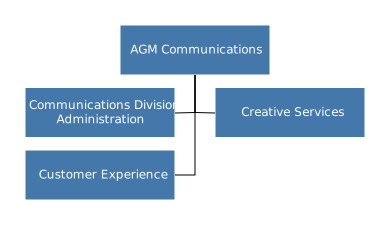
Communications Division Administration
The Communications Division Administration serves as the central hub for SEPTA’s internal and external engagement, ensuring the Authority’s brand, message, and customer experience remain consistent, transparent, and impactful. Through its wide-ranging offerings from creative services and print production to media relations, marketing, and customer advocacy, the division connects SEPTA with both its employees and the public. Collectively, the Communications Division strengthens SEPTA’s operational efficiency, public reputation, and customer trust, making it an essential driver of both organizational performance and regional mobility.
Creative Services
The Creative Services Department fuels SEPTA’s visual identity, storytelling, and brand cohesion across every platform and audience. Through Graphic Services, Print and Sign Shops, Marketing, and Strategic Communications, the Department transforms complex information into engaging, accessible, and visually unified materials that support both internal operations and public outreach. Its teams develop creative concepts, designs, campaigns, and branded materials that not only inform, but also inspire confidence and pride in the Authority’s mission. By aligning visual design, messaging, and promotional strategy, they enhance customer engagement, strengthen public perception, and ensure that every piece of communication, from posters and schedules to digital content and advertising, reflects SEPTA’s commitment to clarity, professionalism, and regional connection.
Graphic Services
Provide creative concept, design, layout, and pre-production services for all departments in the Authority for a vast range of projects including brochures, leaflets, posters, maps, signage, sales materials, and specialty projects. Manages corporate branding program for letterhead, business cards, PowerPoint templates; creates logos and other branding materials for corporate initiatives. Responsible for graphic design of the SEPTA Internet and Intranet websites. Graphic Services and the Print & Sign Shop also provide essential direct mail service to customers, internal SEPTA departments, and constituents requesting bulk distribution of transit timetables, customer service notices, and other brochures and leaflets produced by the Authority.
Print and Sign Shops
Internal production operations for Authority departments and operations. The Print Shop is responsible for printing approximately 7 million transit schedules each year as well as customer brochures, posters, leaflets, maps, mass distribution employee memos, forms, corporate business cards and stationery. The Sign Shop is responsible for producing a variety of system and vehicle signs, decals, posters, and banners.
Media Relations
This department is responsible for informing customers and the general public about SEPTA service and for developing a communications strategy that promotes the Authority locally, regionally, and nationally. Staff works in coordination with key internal departments to tell SEPTA’s story. They build and strengthen relationships with the media through news conferences and events, creating press releases and other content, and distributing information on SEPTA’s website and various social media platforms. The department prioritizes transparency and accessibility, responding to media inquiries 24 hours a day, seven days a week.
Employee Communications
Ensures that 9,000 employees have the information and resources they need to do their jobs effectively and feel connected to the Authority’s mission. The team develops and manages internal communication strategies, tools, and campaigns that strive to reach employees whether they work in the field, on vehicles, in stations, or in offices. This includes producing timely updates on operational changes, safety initiatives and organizational priorities, as well as creating digital and print content tailored to diverse employee audiences and supporting two-way communication between leadership and staff.
Strategic Communications
Helps manage SEPTA’s external communications and public messaging to build trust and strengthen relationships with customers, stakeholders, and the communities SEPTA serves. The function collaborates with media relations, marketing, customer experience, government affairs, and employee communications team to ensure accurate, timely, and consistent messaging about SEPTA’s priorities. By coordinating across departments and engaging with media and digital channels, the function promotes transparency, protects SEPTA’s reputation, and advances strategic initiatives. Strategic Communications play a key role in highlighting the Authority's investments in safety, service improvements, and ensuring stakeholders understand SEPTA’s value to the region.
Marketing and Promotion
The Marking and Promotion department uses innovative and attention-grabbing promotional campaigns to build awareness about SEPTA service. The team utilizes offline and online media, event marketing, loyalty programs, industry-leading social media engagement, and strategic partnerships with area sports teams, businesses, and cultural institutions. The team leverages existing real estate assets to generate incremental sponsorship and naming rights revenue.
Customer Experience
SEPTA CX ensures the delivery of high quality customer experience through a number of interdivisional initiatives. The group is focused specifically on providing better information to riders when and where they need it, as well as leveraging the SEPTA brand, maintaining digital tools, and overseeing the SEPTA Store. Major projects and contributions include the SEPTA Metro Wayfinding project, SEPTA.org redesign, improving the accuracy of bus cancellation data real-time information improvement project, the quarterly Customer Satisfaction Survey, and Control Center information management.
Customer Development
This department advances customer experience through a number of interdivisional initiatives, customer engagement, developing new markets, and supporting COVID-19 ridership recovery efforts. It also coordinates the Authority’s relationships with Mural Arts and other artistic groups.
Customer Service
The Customer Service Center is open daily and is responsible for responding to all inquiries and concerns received via telephone, email, web form, letter, and social media. There are four sections. The agents in the Telephone Information Center provide travel information, while the Contact Center Specialists handle all complaints, commendations, and suggestions. The Access Agents support our paratransit customers. The Social Media Specialists engage customers in all issues. They also produce and use a variety of techniques to build social relationships and perform sophisticated “Customer Intelligence & Analysis (CIA)” research on trending topics that may potentially impact the Authority. The Contact Center staff works closely with the SEPTA Key Call Center. The department also manages seven field locations at major transit hubs where agents engage and support customers.
Consumer Market Research and Analysis
Understanding the needs and expectations of a business’ customers is vital to success. This unit uses qualitative and quantitative research, plus audits by service quality staff, to support the goals of the Division as well as other SEPTA business units. It also oversees the Service Quality Unit, SEPTA’s “Secret Shoppers” that assesses all aspects of the Customer Experience, anywhere and anytime.
Wayfinding and Information
The Wayfinding and Information group serves as the primary steward of service communications and brand consistency within the Customer Experience Department. The team is responsible for developing, maintaining, and implementing a cohesive and intuitive customer information ecosystem that strengthens the SEPTA brand and enhances the rider experience. Core responsibilities include the design, production, and oversight of wayfinding signage, navigational information, timetables, maps, data feeds, apps, and websites ensuring that all service communication tools are accurate, accessible, and aligned with agency standards. Wayfinding and Information establishes and maintains SEPTA’s signage, wayfinding, and branding standards, and produces technical documentation for digital service communication tools. The group manages the creation and distribution of the General Transit Feed Specification (GTFS) data, and designs procedures for detour and service disruption communications to ensure riders receive timely and reliable updates across all platforms. Through cross-departmental collaboration, the team ensures a consistent, user-centered experience for customers across print, digital, and physical media. Additionally, the department oversees the SEPTA Store, developing merchandise lines that promote brand visibility and community engagement through the creative use of SEPTA’s visual identity.
Control Center Information Management
Control Center Information Managers (CCIMs) play a critical role in monitoring and communicating service-related information across SEPTA’s transit network. Their primary responsibilities include real-time monitoring by tracking service delays across Bus, Metro, and Regional Rail modes, including elevator and escalator outages. CCIMs are responsible for information dissemination by providing accurate, timely, and consistent service disruption information to customers and internal SEPTA stakeholders. CCIMs also support operations through Customer Service assistance by way of researching and responding to open Veritas tickets. CCIMs execute SEPTA’s service disruption management by coordinating and communicating planned service changes. CCIM’s provide oversight into SEPTA’s CCTV camera management systems. They perform Rail announcer supervision through daily tasks, monitoring performance, managing shift coverages, overtime, and ensuring compliance with labor agreements. CCIMs foster interdepartmental collaboration by sharing customer-facing information such as bus detours (entered by bus controllers), service advisories and other Authority-wide messages from the Communications Department and provides support to the Customer Service departments in addressing rider inquiries.
Headcount | Expenses | |||||
|---|---|---|---|---|---|---|
Operating | Capital | Total | Net Labor | Non-Labor | Total | |
Communications Division Administration | 9 | 1 | 10 | $1,256 | $181 | $1,437 |
Creative Services | 23 | 0 | 23 | $2,080 | $3,844 | $5,924 |
Customer Experience | 93 | 1 | 94 | $7,383 | $507 | $7,890 |
Total | 125 | 2 | 127 | $10,719 | $4,532 | $15,251 |
Overview
SEPTA’s Corporate Staff consists of a team of experienced transit professionals who are dedicated to providing vision and guidance to the Authority, while optimizing the best use of limited resources. Corporate Staff strives to partner with stakeholders to promote public transit service as a cost-effective, viable travel option for access to work, school, medical service, shopping, leisure activities and tourism. The Corporate Staff is also committed to operating and managing a system which meets the highest standards for customer and employee safety while providing quality services.
Principal Responsibilities
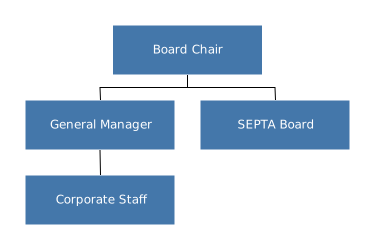
SEPTA Board
Prepares and attests to all Board documentation generated from committee and Board meetings as well as advising and consulting with the Board on all Board-related matters. The Board staff includes a Secretary to the Board, an Assistant Secretary to the Board, a Controller to the Board, and a Board and Government Liaison.
Corporate Staff
In accordance with SEPTA’s Strategic Business Plan, the Corporate Staff remains steadfast in its commitment to safe and efficient operations, prudent fiscal stewardship, and proactive planning to ensure the Authority’s long-term sustainability and resilience.
Headcount | Expenses | |||||
|---|---|---|---|---|---|---|
Operating | Capital | Total | Net Labor | Non-Labor | Total | |
SEPTA Board | 5 | 0 | 5 | $828 | $20 | $848 |
GM & Executive Staff | 13 | 0 | 13 | $3,177 | $152 | $3,329 |
Total | 18 | 0 | 18 | $4,005 | $172 | $4,177 |
Engineering, Maintenance & Construction
Overview
The Engineering, Maintenance & Construction (EM&C) Division oversees all engineering and maintenance activities related to the Authority’s infrastructure, including stations, buildings, bridges, track, communications, and signal and power systems. The Division also manages capital construction projects for both transit and railroad facilities, as well as right-of-way components. Additionally, EM&C is responsible for ensuring the inspection and cleanliness of all stations, tracks, and vehicles across the Authority.
Principal Responsibilities
Program Delivery Office
Responsible for the execution of SEPTA’s Major Projects and Projects of Regional Significance.
Project Management Office/Major Projects
Responsible for the management of all large, multi-discipline projects, including the planning, engineering, and construction of capital projects, improvements to track, signals, traction power, bridges, and other right-of-way assets for all Divisions including the Southwest Connection Improvement Project and the entire Trolley Modernization Project. Develops conceptual designs, cost estimates, and Request for Proposal documents for design projects. Manages the awarded design projects through to completion of design phase.
Coordination
Responsible for all 3rd Party Coordination (track usage, track outage, and Rights-of-Entry). Responsible for infrastructure coordination relating to external entities (PennDOT, City of Philadelphia, Municipalities, and AMTRAK).
Zero Emission Bus
The Zero Emission Bus group plans, develops, manages, and maintains all aspects of the transition to a zero emission bus fleet, including all infrastructure and safety requirements as they relate to battery electric and hydrogen fuel cell electric buses.
Capital Projects
Capital Infrastructure Improvements
Responsible for executing state-of-good-repair improvements to railroad and transit infrastructure involving multidisciplinary elements of power, signals, track, structural, and/or civil systems. These efforts are essential to maintaining a safe and reliable transit network.
Transit/Rail Facilities
Responsible for the engineering design and construction management of capital improvement projects for fixed plant facilities, including improvements to stations, maintenance facilities, and garages for Metro Rail, bus, and Regional Rail operations. Engineering design and construction management encompasses the entire life cycle of projects from conceptual design through final construction on diverse projects such as station ADA compliance and State of Good Repair (SOGR), physical plant improvements, upgraded and new parking facilities, and upgraded and new systems infrastructure to support Metro Rail, bus, and Regional Rail operations.
Rail Vehicle Engineering
Oversees the engineering for light rail, subway-elevated, and Regional Rail fleets and is responsible for all new rail vehicle acquisitions.
New Rail Vehicles
Oversees the purchase of all new rail vehicles. Manages the procurement, production, inspection, acceptance, and contract deliverables (e.g., spare parts, manuals, and warranty administration) for various rail vehicle contracts.
Maintenance
Bridges and Buildings
Responsible for engineering services including design, inspections, facilities & construction management, and implementation of major SOGR projects. Projects include both Operating and Capital rehabilitation and reconstruction of bridges, stations, facilities, and maintenance shop equipment for the City Transit, Suburban Transit, and Regional Rail Divisions. Group performs regular inspections of all bridges, tunnels, buildings, other structures, and fixed plant infrastructure in accordance with State and Federal Regulations and in response to emergency call-outs. Provides all major force account construction projects and maintenance of stations, buildings, bridges, maintenance shops, and depots in the City and Suburban Transit/Regional Rail Divisions and electrical/mechanical infrastructure in the City Transit and Regional Rail Divisions.
Civil
Responsible for all civil engineering design, 3rd party coordination and related Infrastructure Safety Renewal Program (ISRP) projects. Responsible for engineering design and construction management of right-of-way drainage and stormwater infrastructure projects. Responsible for site development and stormwater management designs and construction as part of the infrastructure SOGR projects for stations and maintenance facilities.
Track & Utilities Department
Responsible for the inspection, maintenance, and construction of track and right-of-way areas. Provide track engineering and design services for all maintenance and capital construction projects. Responsible for the Courtland Track Shop to support requirements for routine and specialty track design and fabrication. Responsible for the Midvale Utility Group, which oversees the scheduling, use, maintenance, and deployment of non-revenue and utility vehicles. Responsible for all track related ISRP Projects.
Communications and Signals (C&S)
Responsible for the inspection, testing, maintenance, and construction of the signal system. Provide engineering and design services for all signals and communications maintenance and construction projects. Responsible for all radio, telecommunications, and Regional Rail communication systems, including maintenance and construction. Responsible for the engineering and construction for capital projects involving communication and signals infrastructure. Responsible for all C&S related ISRP Projects.
Power
Responsible for the inspection, maintenance, and reconstruction of electric traction and signal power systems and electrical infrastructure. Responsible for engineering and design services for all related maintenance and construction projects. Responsible for engineering and construction for capital projects involving power and electrical infrastructure. Responsible for all power related ISRP Projects.
Custodial Services
Responsible for the inspection and cleanliness of stations, tracks and vehicles on all modes throughout the Authority.
Headcount | Expenses | |||||
|---|---|---|---|---|---|---|
Operating | Capital | Total | Net Labor | Non-Labor | Total | |
Chief Engineer Staff | 5 | 0 | 5 | $674 | $3 | $677 |
Program Delivery Office | 2 | 16 | 18 | $194 | $2 | $196 |
Capital Projects | 10 | 64 | 74 | $1,087 | $131 | $1,218 |
Maintenance | 1807 | 474 | 2,281 | $153,358 | $21,112 | $174,470 |
Total* | 1824 | 554 | 2378 | $155,313 | $21,248 | $176,561 |
*Utilities not included in non-labor total | ||||||
Overview
The Finance Division develops and monitors the financial plan for the Authority, including the development of operating and capital budgets, federal, state, and local grants, financial services and operations, and all accounting functions, including the preparation of monthly, quarterly, and annual financial statements.
Principal Responsibilities
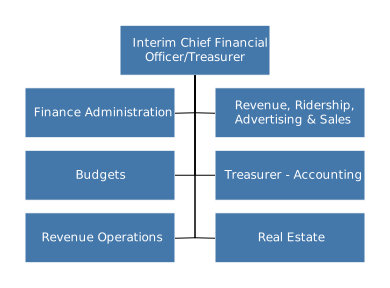
Budgets
Budgets delivers collaborative financial planning and stewardship that keeps SEPTA moving sustainably forward. It achieves this through the work of the Capital Budget and Grant Development and Operating Budgets departments.
Capital Budget and Grant Development
The Capital Budget and Grant Development group develops the annual Capital Budget and the twelve-year Capital Program. In so doing, the group: prepares, maintains, executes, and monitors federal, state, and local grants from inception to grant close-out; develops and maintains the transit capital projects of the regional Transportation Improvement Program (TIP); and prepares materials associated with competitive grant applications and awards.
Contract Grant Compliance
Ensures compliance with funding agency regulations for approved capital projects, planning studies, force account plans, and all other procurement related activities. Responsible for the Standard Form Contract updates and mandatory revisions. Participates in updating the SEPTA Procurement Manual, P-Card Policy, and the Desktop Procedures. Monitors compliance with certified wage rates on SEPTA construction projects per the Davis-Bacon Act. Audits small and micro procurements for compliance. Acts as the liaison for all Procurement related reviews and audits.
Operating Budgets
The Operating Budgets group develops the annual Operating Budget. In so doing, the group serves as the Authority’s fiscal gatekeeper through: the annual budgeting process, including public hearings; communications of financial and statistical information for decision-making purposes; monthly reporting; daily transactional reviews and approvals; and specialized cost and performance analysis.
Revenue, Ridership, Advertising and Sales
Form a centralized leadership capacity to coordinate multifaceted operations including revenue generation from customer fare and organizational quantity fare purchases. Monitors and officially reports ridership levels and affiliated revenues. Coordinate the Division’s participation in all financial, operational and customer facing aspects to further the advancement of the SEPTA Key Program.
Revenue and Ridership Management
Develop and report monthly ridership and revenue levels. Manage all ridership and revenue data and issue reports as market conditions demand. Issue all required revenue and ridership reports to governmental and ancillary agencies. Develop and support all passenger revenue pricing and tariffs and incorporate data received from the SEPTA Key Program into the data stream.
Sales
Administers and/or conducts the sale of all customer fares within the SEPTA service area. Directly supports organizations purchasing fares on behalf of employees or clients including over 1,000 external sales venues such as corporations, school districts, and social service agencies. Works closely with various teams to ensure the effective use of SEPTA Key media.
Customer Support Services
Manages the daily operation of ten full-service sales centers, 73 satellite sales locations and the third-party contract to supply customer support services. Directly oversees the daily operation of the SEPTA Key Contact Center. Validates and issues refunds and adjustments for lost rides and unneeded fare products. Manages the agreements to supply SEPTA with cards media used for customer travel on SEPTA.
Treasurer - Accounting
Coordinate, manage, and direct the activities of the Finance Division including accounts payable/receivable, treasury operations, and all accounting functions. Ensure that financial resources are used effectively to maximize capital investments and to maintain access to the capital markets on reasonable terms and conditions. Ensure sound financial controls, intact corporate governance, and accurate, timely financial planning and analysis to support the activity of the Authority. Develop and coordinate the use of capital markets and debt financing strategies to help guide and support the Authority’s capital and operating goals. Coordinate the strategy for defined benefit and defined compensation plans to develop a sustainable retirement funding strategy for Authority retirees past, present, and future. Manage the strategy for short- and medium-term investments ensuring sufficient returns and liquidity. Ensure accurate accounting of all financial activities inclusive of fixed assets, cash management, operating and capital grants, investment activity and operating revenue. Ensure timely and accurate development of independently audited financial statements and oversee relationships with all external financial vendors and stakeholders.
General Accounting
Manage the Authority’s financial reporting and accounting activities in accordance with generally accepted accounting principles (GAAP) and governmental regulations. GAAP is a set of procedures and guidelines used by companies to prepare their financial statements and other accounting disclosures. The standards are prepared by the Governmental Accounting Standards Board (GASB). The department is responsible to produce timely and accurate financial reports and properly maintain the accounting system and related internal control structure, which includes managing the monthly and annual financial general ledger close process. Prepare and issue monthly financial and statistical reports to the SEPTA Board and senior management. Prepare required quarterly and audited financial reports that are issued to various financial institutions and government agencies that provide debt financing or subsidies to the Authority.
Payroll
Process the Authority’s payroll in a timely and accurate manner. Ensure that payroll-related data has been balanced and reconciled. Process all wage deductions and tax withholdings. Responsible for reporting of tax withholdings and all quarterly and annual tax returns. Prepares all bargaining unit contractual wage increases. Ultimately responsible for all payroll-related record keeping as well as verifying the reliability of the data.
Corporate Treasury
The Corporate Treasury group within the finance division is responsible for managing the financial assets of the Authority including its cash, debt, and investments portfolios, its real estate portfolio, as well as all of the Authority’s risk financing and insurance program needs.
Revenue Operations
Revenue Operations' mission is to ensure the Authority’s revenue is collected, transported, and deposited in a safe and secure manner. The mission also includes the timely maintenance and repair of all revenue equipment.
Revenue Transportation and Collections
Manages the collection, transportation, and deposit of passenger revenues and fare instruments. This includes Bus, Sub-EL, and Regional Rail revenue.
Revenue Services
Ensures timely processing, counting, and reconciliation of passenger revenue, as well as the distribution of fare instruments. This includes Bus, Sub-EL, and Regional Rail operations.
Revenue Equipment Maintenance
Performs preventive/corrective maintenance and overhaul of fare collection equipment and devices on all modes of transportation (Bus, Sub-El, and Regional Rail). Additionally, support the deployment of SEPTA Key 2.0.
Revenue Engineering
Provides engineering and design support for the revenue system including specifications, drawings, equipment modifications, system upgrades, and Payment Card Industry (PCI) compliance. Additionally, support the deployment of SEPTA Key 2.0.
Railroad Parking Equipment Maintenance and Servicing
Responsible for managing third-party contractors for maintenance on gated parking lot and garage equipment. Also responsible for the enforcement of all open lot parking stations.
Real Estate
The Real Estate department is responsible for managing and administering all agreements related to SEPTA’s real properties and third-parties, which includes acquisitions, transaction management, support with billing and rent collection, negotiating lease renewals, projecting revenue, and coordinating internally with SEPTA's Finance department. Real Estate staff supports Engineering, Operations, B&B facilities, Planning & Strategy, Government Affairs, C&S, Parking (Revenue Operations), General Accounting and the Claims and Litigation departments by providing property rights research, comprehensive responses to interrogatories, verifications, expert testimony at depositions, arbitrations, and trials to meet the requirements and obligations associated with SEPTA’s real property portfolio.
Additionally, the Real Estate department’s responsibilities include managing SEPTA third-party property management companies, acquiring real estate for transit projects, establishing fair compensation appraisals, managing property sales and leases, identifying and mapping properties, maintaining real estate documents, developing and managing information systems/databases, managing right-of-way, and responding to information requests from multiple internal and external stakeholders. The Real Estate Department also manages TOC development projects.
Headcount | Expenses | |||||
|---|---|---|---|---|---|---|
Operating | Capital | Total | Net Labor | Non-Labor | Total | |
Finance Administration | 7 | 0 | 7 | $1,213 | $304 | $1,517 |
Budgets | 15 | 5 | 20 | 1,650 | 442 | $2,092 |
Treasurer - Accounting | 50 | 0 | 50 | 4,683 | 1,284 | $5,967 |
Revenue, Ridership, Advertising and Sales | 42 | 2 | 44 | 3,511 | 16,698 | $20,209 |
Revenue Operations | 176 | 0 | 176 | 15,849 | 1,524 | $17,373 |
Real Estate | 5 | 2 | 7 | 320 | 5152 | $5,472 |
Total | 295 | 9 | 304 | $27,226 | $25,404 | $52,630 |
* Utilities not included in non-labor total | ||||||
Overview
The Information Technology Division is dedicated to delivering world-class service and support to our customers and associates. We provide the leadership and deployment of technological solutions that benefit our customers and positively contribute to the overall success in achieving the Authority's goals. We are responsible for the Data Center, Network, and Hardware; Business and Operations Software; Real-Time and Customer-Facing Systems; and business intelligence and Artificial intelligence.
Principal Responsibilities
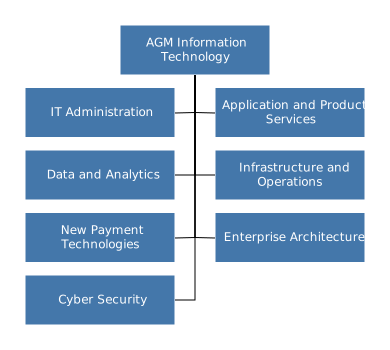
IT Administration
Manages and ensures a consolidated strategy for technology-based service contracts, maintaining a consistent approach for future system transitions. Working closely with the EA division, this group ensures all IT policies and procedures are current and reflect recent regulatory and technological best practices. Responsible for coordination with internal and external IT auditors. Provides an enterprise-wide approach to identify, prioritize, and successfully execute a technology portfolio aligned with SEPTA's strategic goals and vision.
Enterprise Architecture
Enterprise Architecture (EA) aligns business objectives with technology capabilities by providing a holistic view of the organization's business processes. The EA group proactively supports architecture, governance, strategy and results in improved technological investment strategies. Ensure the strategic approach, smooth operation, and progressive evolution of SEPTA's architectural landscape. They provide foundational standards and constructs that drive consistency, scalability, and sustainability of technology solutions across the SEPTA enterprise.
Cyber Security
Manages and supports the effort of protecting customer and employee data from intrusion or data breach. Engages cyber security committee meetings with key stakeholders that focus on business applications, enterprise databases, operational systems, and fare collection to ensure protocols and procedures are in place to minimize the threat of intrusions, malware, and data breaches. Works with outside agencies and professional affiliations, including law enforcement, to aid in understanding new cyber security risks/threats and determining what remedies are available to protect and minimize the impact.
Data and Analytics
Defines, manage, and advance enterprise information management principles, policies, governance and programs for stewardship, advocacy, and custodianship of data and analytics, in concert with legal, information security, and corporate risk and compliance offices. Delivers advanced analytics, artificial intelligence solutions to enable data-driven business decision making. Responsible for processes and data governance to ensure that data pulled from various sources meets quality standards, is curated, and enhanced for analytical use, driving towards a "single source of truth".
Infrastructure and Operations
Provides technology operations stability and access security on a 7-day/24-hour basis, including problem management, disaster recovery, vehicle technology. device, telecommunications, technical infrastructure management/support and change control. Maintains the technology infrastructure necessary for the authority’s systems. Sets standards for hardware and software used across the networks and installs, supports, and maintains the authority’s network infrastructure.
Application and Product Services
Manages the development and implementation of software applications. Maintains and enhances existing systems Authority-wide. Software applications include large-scale enterprise systems, divisional customized applications, web and mobile applications. Manage critical operational technologies for public-facing systems, such as digital signage for rail stations, real-time information of vehicle location on the SEPTA Mobile App and website for customers. Manages the support of Control Center specialty technology systems, real-time systems, and public-facing applications. Responsible for the strategic design and development of mobile applications for smartphones and advanced web applications to service SEPTA customers.
New Payment Technologies
Manages the current automated fare collection system. Directs the multi-phase SEPTA Key Program to transform SEPTA’s aging revenue collection system into a modern, efficient, and convenient system for customer payment and agency collection of fare revenue.
Headcount | Expenses | |||||
|---|---|---|---|---|---|---|
Operating | Capital | Total | Net Labor | Non-Labor | Total | |
IT Administration | 3 | 4 | 7 | $410 | $1,808 | $2,218 |
Application and Product Services | 27 | 0 | 27 | $2,938 | $1,266 | $4,204 |
Data and Analytics | 9 | 1 | 10 | $1,137 | $1,895 | $3,032 |
Infrastructure and Operations | 30 | 3 | 33 | $3,224 | $9,842 | $13,066 |
Enterprise Architecture | 4 | 1 | 5 | $400 | $107 | $507 |
Cyber Security | 5 | 2 | 7 | $701 | $1,773 | $2,474 |
New Payment Technologies* | 2 | 8 | 10 | $267 | $10,000 | $10,267 |
Total | 80 | 19 | 99 | $9,077 | $26,691 | $35,768 |
*Utilities not included in non-labor total | ||||||
Overview
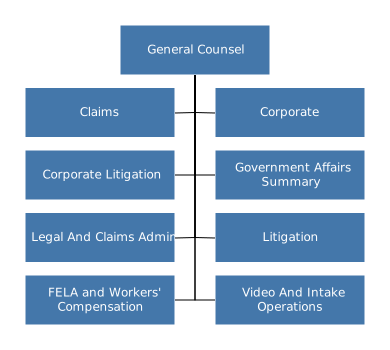
The Office of General Counsel consists of the Claims, Corporate, Government Affairs, Litigation and Corporate Litigation, FELA and Workers' Compensation, and Video and Intake Operations Departments, all reporting to the General Counsel.
Principal Responsibilities
Claims
The Claims Unit is responsible for the handling of personal injury and property damage claims. Many claims are handled in tandem with attorneys in the Litigation Department, from first notice of the claim through its final resolution. Claim handling involves a thorough and detailed examination of evidence, a determination of liability and assessment of potential damages. The existence of pertinent video provides a key piece of beneficial evidence, one which often provides a dispositive defense to a claim. If the Authority is liable to an individual for injuries or property damage, then Staff will attempt to settle the claim in an equitable and prudent manner. For claims where the Authority is either not liable or is not able to obtain a just settlement, the case is defended in court by the attorneys of the Litigation Department.
Corporate
Lawyers within the Corporate Department negotiate and draft legal contracts and other documents that support and promote the activities of client departments. Counsel advises management on matters that have legal implications, assists other departments in drafting documents that have legal-related elements, and works with outside attorneys handling matters involving specialty areas of the law. The Corporate Department is involved in all transactional legal matters such as those related to procurements, construction, technology contracts, real estate, environmental law, energy, sustainability, regulatory compliance, corporate governance, railroads, and property use.
Government Affairs
The Government Affairs Department – comprised of Government, Legislative and Community Relations – is responsible for communicating the Authority’s official position on key issues, enhancing public perception, and developing campaigns that promote transit awareness and ridership growth. The Department builds and maintains strong working relationships with federal, state, and local elected officials and transit stakeholders to ensure SEPTA’s priorities and message effectively reaches lawmakers and the public.
Litigation
The Litigation Department is responsible for representing SEPTA in personal injury and property damage claims once a lawsuit is filed. Attorneys within the Litigation Department (as well as outside counsel who are managed by Department attorneys) handle all aspects of litigation from pleadings through discovery and up to and including trial. The attorneys evaluate cases and make settlement recommendations. When appropriate, the Department attorneys negotiate final settlements. The Litigation Department also handles appellate cases in the Commonwealth Court and Supreme Court of Pennsylvania on issues regarding SEPTA cases as well as others that may affect SEPTA as a mass transit agency and/or as a Commonwealth Party.
Corporate Litigation
Lawyers within the Corporate Litigation Department represent SEPTA in civil actions that are other than personal injury and property damage. Corporate litigation actions include, labor and employment matters, civil rights cases, contracts and construction suits, and trademark registration and infringements. This Department also provides legal counsel to management on employment matters and statutes (including Title VI, ADAAA, ADEA, FMLA, FLSA, and USERRA) and employment concerns before state and federal administrative agencies. Additionally, this Department handles the intake, response, and appeal of requests for Authority records submitted under the Pennsylvania Right-to-Know Law, third party subpoena requests for records and litigation holds.
FELA and Workers' Compensation
The FELA and Workers' Compensation Department manages SEPTA’s programs to compensate injured employees who have claims under the Commonwealth’s workers’ compensation laws or under the Federal Employers Liability Act (FELA). Department Staff oversee a third-party administrator of workers’ compensation claims, handles medical and indemnity management, coordinates internal vocational rehabilitation, and manages all alternative and transitional duty programs. Staff also administers supplemental benefits as prescribed by bargaining unit contracts. FELA Unit Staff oversee a third-party administrator of FELA claims which monitors, settles, and oversees litigation of claims of injured Regional Rail workers.
Video and Intake Operations
The Video and Intake Unit is responsible for performing intake functions for all matters, claims and requests that come into the Office of General Counsel; seeking and compiling all information, data and records needed to handle all OGC matters; and featuring those functions associated with carrying out the Authority’s video surveillance program. The video program includes planning, collecting, reviewing, preserving, storing, and producing data from video systems on SEPTA vehicles and in stations. Staff within this Department also respond to and handle requests for, notification of, and production of employee witnesses for court matters.
Headcount | Expenses | |||||
|---|---|---|---|---|---|---|
Operating | Capital | Total | Net Labor | Non-Labor | Total | |
Legal and Claims Admin | 8 | 1 | 9 | $1,298 | $256 | $1,554 |
Litigation | 29 | 0 | 29 | $2,907 | $3,831 | $6,738 |
Corporate | 9 | 0 | 9 | $1,235 | $7,047 | $8,282 |
Video And Intake Operations | 32 | 0 | 32 | $2,461 | $2,100 | $4,561 |
Corporate Litigation | 5 | 0 | 5 | $576 | $1,055 | $1,631 |
FELA and Workers' Compensation | 7 | 0 | 7 | $677 | $115 | $792 |
Claims | 26 | 0 | 26 | $2,316 | $1,908 | $4,224 |
Government Affairs Summary | 6 | 4 | 10 | $619 | $590 | $1,209 |
Total | 122 | 5 | 127 | $12,089 | $16,902 | $28,991 |
Overview
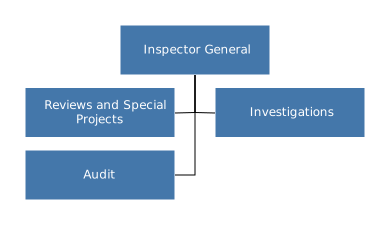
The Office of Inspector General (OIG) is firmly committed to its core mission to identify and eliminate fraud, waste, and abuse throughout SEPTA. Our team of dedicated investigators, auditors and compliance officers identify systemic vulnerabilities and inefficiencies, and probe criminal and administrative misconduct, including workplace violence, by employees, contractors, and vendors. Through reports of audits, reviews and investigations, the OIG strives to make thoughtful recommendations to improve processes and to direct SEPTA stakeholders and management to implement corrective actions. The OIG includes three sub-divisions: (i) Internal Audit; (ii) Compliance for Procurement and Regulatory Affairs; and (iii) Investigations.
Principal Responsibilities
Reviews and Special Projects
Reviews & Special Projects focuses on projects that involve risks such as fraud, waste, abuse, as well as safety concerns and challenges related to Procurement and Supply Chain management. Comprised of lawyers, auditors, and compliance professionals, the team plays a critical role in evaluating SEPTA’s systems, procedures, processes, policies, and contracts. Their efforts are focused on identifying areas of concern while enhancing transparency, accountability, and financial oversight.
Audit
Audit is an independent, objective, internal review and consulting activity designed to add value and improve the organization’s operations. It provides a systematic, disciplined approach to evaluate financial risk/exposure and improve the effectiveness of risk management, internal control, and governance processes. Internal Audit conducts financial, compliance, and operational audits of departments within the Authority in accordance with a Board-approved Annual Audit Plan. The Department is also responsible for the review of cost proposals and audits of cost reimbursement contracts and change order/claims. Additionally, Internal Audit provides a wide range of internal consulting support to departments upon request. Audit is comprised of Internal Audit, Information Technology, and Contract Audit sections.
Internal Audit
Internal Audit is responsible for reviewing all areas within the Authority by performing formal audits of an entire process or independent reviews of a particular activity or account balance.
Information Technology
A specialized sub-unit of Audit that is responsible for reviewing new and existing computer applications, access security, and hardware. Independent data extracts and reporting support are also generated for Internal Audit and other divisions.
Contract Audit
Contract Audit is responsible for auditing or reviewing third-party cost data in accordance with established policies and federal requirements. The work includes reviews of pre-contract cost proposals and audits of actual costs incurred on cost-plus-fixed-fee contracts. In addition, Contract Audit performs audits or reviews of cost documentation in support of change orders and claims.
Investigations
OIG investigators are responsible for conducting independent investigations related to fraud, waste, abuse, mismanagement, and serious employee misconduct (illegal, criminal). The group consists of sworn law enforcement officers, former prosecutors and former federal agents who conduct criminal, civil and administrative investigations. In addition, the OIG works in partnership with local, state, and federal law enforcement and refers criminal violations by SEPTA business partners, employees, and vendors. Violations of SEPTA’s rules and policies are referred to management for disciplinary action.
Headcount | Expenses | |||||
|---|---|---|---|---|---|---|
Operating | Capital | Total | Net Labor | Non-Labor | Total | |
Investigations | 8 | 0 | 8 | $988 | $81 | $1,069 |
Audit | 14 | 0 | 14 | $1,407 | $19 | $1,426 |
Reviews and Special Projects | 4 | 0 | 4 | $538 | $1 | $539 |
Total | 26 | 0 | 26 | $2,933 | $101 | $3,034 |
Overview
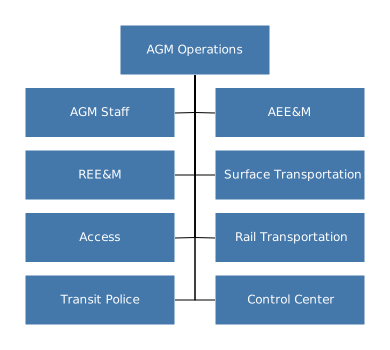
The Operations Division provided 221.7 million annual passenger trips in Fiscal Year 2025, while operating 87.6 million vehicle miles. Total passenger miles exceeded 925.8 million. The Division operates 2,279 revenue vehicles on 147 fixed routes, which have approximately 1,570 route miles and over 600 miles of track. The Operations Division also operates and provides service to 290 rail passenger stations and 21 bus passenger stations.
Principal Responsibilities
Surface Transportation
Operates surface transit modes throughout the five-county service area with service originating from nine operating locations in the region. Each operating district has full responsibility for transportation service of the transit fleet in that location. The nine operating districts operate a total of 104 bus routes and 34 seasonal service routes. It should be noted that the number of bus routes identified by operating district in this section differs from the total number reported elsewhere, due to 16 bus routes that are operated out of more than one district as operating conditions necessitate. The nine operating districts in Surface Transportation are:
1.Allegheny - operates 8 bus routes and 8 seasonal service routes
2.Callowhill - operates 12 bus routes, 2 trolley lines (T1 and G1) and 1 seasonal service route
3.Comly - operates 15 bus routes and 9 seasonal service routes
4.Elmwood - operates 4 Trolley (Light Rail) routes T2-T5
5.Frankford - operates 16 bus routes and 7 seasonal service routes
6.Midvale - operates 24 bus routes and 7 seasonal service routes
7.Southern - operates 16 bus routes and 2 seasonal service routes
8.Frontier - operates 24 bus routes
9.Victory - operates 20 bus routes, 2 trolley (light rail) routes D1 and D2, and 1 heavy rail route M1
Access
Access is responsible for the operation of SEPTA’s two demand response services, ADA Paratransit and Shared Ride Program transportation. This full-service operation, from advance reservations and customer service to shared trip completion, operates under the name “SEPTA Access”. It coordinates development of Requests for Proposals through to awarded contracts for private operation of new services and provides for the efficient administration of existing contract carrier operations.
Access coordinates SEPTA’s compliance with the Americans with Disabilities Act (ADA) as it pertains to service, equipment, and facilities, advising other operating departments on implementing accessible fixed-route service and facility improvements. Access also serves as liaison between various SEPTA Divisions and the Disability Community.
Access administers eligibility screening for the following programs: PA Disability Transit ID, Senior Citizen Transit ID, and Personal Care Attendants on Transit ID in addition to ADA paratransit and the lottery-funded Shared Ride Program. Access also provides travel training by certified professionals to instruct customers how to travel independently on public transportation. This service is offered on a one-to-one basis or as part of designed instruction for a group in partnership with several local universities and Philadelphia high schools. Access oversees the Authority’s customized small bus operations and public-private partnerships via its Contract Operations Department.
SEPTA Access
ADA Services
Provide advance-reservation, ride-sharing paratransit service for eligible disabled riders in Bucks, Chester, Delaware, Montgomery, and Philadelphia counties.
Shared Ride Program (SRP)
Provide advance-reservation, ride-sharing transportation for Philadelphia County riders aged 65 and older, regardless of income or disability status.
Contract Operations
Breeze
Operates SEPTA's small bus service known as the Horsham "Breeze". This service provides transportation designed to meet the needs of employers in the Willow Grove and Horsham business centers. The Breeze operates weekday and Saturday service.
LUCY
Operates a fixed route bus loop in the University City area of West Philadelphia. The service is funded by subsidies from the University City District and operates weekday service only.
Cornwells Heights Shuttle
Operates a small bus shuttle within the 1,600-space park-and-ride lot at Cornwells Heights train station. Cornwells Heights operates weekday service only.
Automotive Equipment Engineering & Maintenance (AEE&M)
Bus Maintenance
Performs all preventive maintenance aspects for bus, trolleybus, and non-revenue generating fleets as well as bus vehicle preventive maintenance overhauls at eleven maintenance facilities and backshops.
Bus Vehicle Engineering
Oversees the engineering for bus, trolleybus, and non-revenue generating vehicle fleets. Responsible for the acquisition of new fleets of vehicles including bus, Access, and non-revenue fleet vehicles.
Engineering
Provides all engineering support including specifications, drawings, vehicle modifications, and system upgrades for all bus fleets. Investigates and resolves bus and non-revenue fleet technical issues. Support is provided to heavy maintenance facilities and Access vehicle maintenance.
Rail Equipment Engineering & Maintenance (REE&M)
Rail Transit Maintenance
Performs all preventive maintenance aspects for City Trolley, Media Sharon Hill Line, Norristown High Speed Line, and Subway-Elevated fleets as well as all rail vehicle overhauls at 11 maintenance facilities and backshops plus technical support for mechanical desks located in the Control Center.
Regional Rail Maintenance
Performs all preventive maintenance aspects for the Regional Rail fleet as well as all Regional Rail vehicle overhauls at 5 maintenance facilities.
Rail Vehicle Engineering
Oversees the engineering for light rail, subway-elevated, and Regional Rail fleets and is responsible for all new rail vehicle acquisitions.
Engineering
Provides all engineering support including specifications, drawings, vehicle modifications, and system upgrades for all rail fleets. Investigates and resolves rail fleet technical issues. Support is provided to heavy maintenance facilities.
Control Center
The Control Center is a centralized facility that manages the safe and efficient movement of bus, trolley, Metro Rail, and Regional Rail operations and coordinates with the Communications Division to provide customer information and service alerts to our passengers. All Control Center functions and associated equipment are located at SEPTA’s 1234 Market Street headquarters on the 19th floor. The Control Center personnel are responsible for ensuring that SEPTA’s established service levels are maintained 24 hours a day, 7 days a week.
Special Projects
The Special Projects department will effectively plan, coordinate, and execute high-level transit services for special events, with a focus on safety, customer service, efficiency, sustainability, and stakeholder engagement. We centralize and standardize projects related to special events.
Rail Transportation
Regional Rail
Oversee all transportation, customer service, and station operation for the railroad system. The Regional Rail system includes 280 route miles and 13 lines or branches.
Metro Rail
Provides train and customer service to the L (Market-Frankford Line) and B (Broad Street Line).
Subway-Elevated Transportation Services
The L operates trains each weekday between the Frankford Transportation Center and the 69th Street Transit Center. The B operates trains each weekday between the Fern Rock Transportation Center and NRG Station as well as along the Ridge Avenue Spur. Transportation Services also oversees the cashiers who assist customers with fare instrument purchases and navigation of the Subway-Elevated system.
Transit Police
SEPTA’s Transit Police are tasked with preventing and investigating crime; establishing an atmosphere of safety and security throughout each of our transit modes; and serving as public safety ambassadors for the transit system.
Headcount | Expenses | |||||
|---|---|---|---|---|---|---|
Operating | Capital | Total | Net Labor | Non-Labor | Total | |
AGM Staff | 7 | 0 | 7 | $1,428 | $8 | $1,436 |
Rail Transportation | 1,317 | 0 | 1,317 | $121,971 | $5,839 | $127,810 |
Surface Transportation | 2,872 | 6 | 2,878 | $268,864 | $607 | $269,471 |
Automotive Equipment Engineering & Maintenance | 695 | 82 | 777 | $63,741 | $32,773 | $96,514 |
Rail Equipment Engineering & Maintenance | 714 | 171 | 885 | $72,893 | $29,418 | $102,311 |
Access | 102 | 0 | 102 | $9,730 | $6,074 | $15,804 |
Control Center | 105 | 0 | 105 | $10,867 | $47 | $10,914 |
Transit Police | 286 | 2 | 288 | $31,445 | $4,456 | $35,901 |
Total* | 6,098 | 261 | 6,359 | $580,939 | $79,222 | $660,161 |
*Fuel, Utilities, and Purchased Transportation not included in non-labor total. | ||||||
Overview
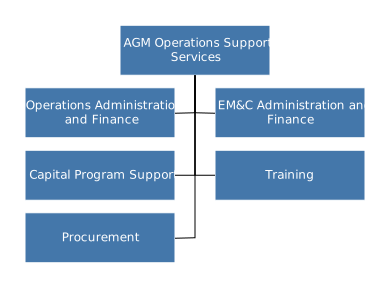
The Operations Support Services Division consists of Operations Administration and Finance, EM&C Administration and Finance, Capital Program Support, Training, Procurement and Supply Chain Management, and Procurement Transformation departments.
Principal Responsibilities
Operations Administration and Finance
Plans, organizes and leads all administrative and financial activity for Rail Transportation, Surface Transportation, Vehicle Engineering and Maintenance, Access, Transit Police, and the Control Center. Liaisons with various staff departments, including Finance, People and Culture, Legal, and Procurement as needed.
EM&C Administration and Finance
Plans, organizes and leads all administrative and financial activity for the Bridges & Buildings, Power, Track, Communications & Signals and Custodial departments. Liaisons with various staff departments, including Finance, People and Culture, Legal, and Procurement as needed.
Capital Program Support
The Capital Program Support Department promotes stewardship of SEPTA’s financial, infrastructure, and rolling stock assets throughout planning and design, project delivery and service life. The Department establishes and enforces procedures to monitor delivery of the capital program, maintain assets throughout their duty cycle, and report both asset and project performance to SEPTA stakeholders. Capital Program Support oversees the Transit Asset Management Program, the Quality Management System, project controls, and capital program performance.
Training Department
Provides technical and soft skills training solutions focused on integrated programs and curriculum that improve employee performance, productivity, development, and communication. Employees are provided with an on-demand self-paced learning environment via Enterprise Learning. The department provides training classes and solutions to teach new skills and retrain employees as required to ensure the workforce has a comprehensive understanding of regulations, procedures, and policies, in addition to being equipped to perform assigned duties and functions. The Training Department is responsible for developing and administering the highest quality training and recertification programs for transportation and maintenance staff.
Procurement and Supply Chain Management
The Procurement and Supply Chain Management Department is responsible for SEPTA’s procurement, materials management, contract grant compliance, department's business process and support services, supply chain management, and contract administration.
Business Process and Support Services
Provide analytical reports, system administration, enhancements, contract processing, records management, and training support for the department. Administer Authority-wide programs such as e-procurement, electronic stockless stationery, Procurement Card, and the Materials Management/Purchasing system.
Materials Management (Automotive and Rail)
Perform analysis, forecasting, and identification of inventory requirements to determine adequate stocking levels to effectively purchase/lease stock and non-stock rail and vehicle parts, material, equipment, supplies, and services, except for major vehicle procurements. Provide direct field support to maintenance directors and shop personnel. Coordinate Authority-wide inventory reduction and control programs. Maximize return on investment through Asset Recovery programs and long term, market-based scrap metal contracts. Perform inventory requirements planning for vehicle overhaul programs and various maintenance projects.
Materials Management (Infrastructure)
Perform analysis, forecasting, and identification of inventory requirements to determine adequate stocking levels to effectively purchase stock and non-stock infrastructure, material, equipment, supplies, and services. Provide direct field support to maintenance directors and shop personnel. Perform requirements planning for various capital project programs and various maintenance projects.
Supply Chain Management
Plan and coordinate inventory requirements with all Operations areas to meet short and long-term material needs. Administer storeroom operations, warehousing and distribution functions, including receipt, storage, issuance and control of all stock materials for the Authority's diversified fleet of vehicles, for vehicle overhaul programs and for infrastructure maintenance requirements.
Contract Administration
Perform solicitations, contract awards, and post-award administration including change orders, dispute resolution and contract closeout. Administer contracts by overseeing vendors to fulfill contractual obligations.
Construction and Vehicle Acquisition
Perform procurement and contracts' post-award administration of project-specific architectural, engineering, and associated construction-related services, new construction, and renovations of facilities and structures. Responsible for solicitation, award, and administration of large scale new construction projects, infrastructure hardening and resiliency programs, as well as major equipment purchases, including rail and bus fleets.
Professional and Technical Services
Procure and administer employee benefits, insurance, and associated passenger services such as paratransit and fixed route. Solicit, award, and administer professional services contracts including state and federal legislative services, advertising, brokers and lease and management services. Also includes technical services such as landscaping, janitorial, IT support maintenance, and pest extermination.
Procurement Transformation
SEPTA’s Procurement Transformation is a comprehensive effort aimed at optimizing SEPTA’s end-to-end procurement and supply chain processes. It consists of 20 targeted initiatives that address key operational pain points such as spend segmentation, requisition intake, staff summary approvals, demand planning, contract purchasing, and supplier performance. The program emphasizes simplification, standardization, automation, and strategic alignment across departments. It also includes cultural and organizational health improvements, enhanced governance and reporting, and technology enablement. Each initiative is structured with clear objectives, timelines, KPIs, and dependencies, ensuring a phased and measurable approach to driving efficiency, accountability, and collaboration throughout the organization.
Headcount | Expenses | |||||
|---|---|---|---|---|---|---|
Operating | Capital | Total | Net Labor | Non-Labor | Total | |
Operations Support Services Staff | 4 | 2 | 6 | $676 | $0 | $676 |
Administration and Finance Staff | 49 | 7 | 56 | $4,525 | $19,695 | $24,220 |
Training Summary | 103 | 0 | 103 | $9,930 | $3,150 | $13,080 |
Capital Program Support | 22 | 22 | 44 | $2,098 | $602 | $2,700 |
Procurement | 136 | 6 | 142 | $11,429 | $257 | $11,686 |
Total* | 314 | 37 | 351 | $28,658 | $23,704 | $52,362 |
*Snow Removal, Fuel and Utilities not included in non-labor total | ||||||
Overview
The People and Culture Division plays a central role in supporting employees throughout their entire journey with the Authority – from recruitment and onboarding to career development and meaningful engagement in the workplace culture. The division oversees the full employee talent lifecycle – including attracting, recruiting, testing, hiring, onboarding, retention, and offboarding. Guided by our mission, we support employees from the very start of their journey through key transitions and beyond, fostering a culture of care, growth, and accountability.
Principal Responsibilities
Recruitment and Benefits Summary
Recruitment
The Recruitment Department is responsible for managing the full employee lifecycle, with a strategic focus on attracting, selecting, onboarding, and transitioning top talent. We ensure a diverse, qualified, and high-performing workforce by applying equitable hiring practices and maintaining strict compliance with all applicable employment laws and regulations. Through data-driven recruitment strategies and continuous process optimization, we support organizational growth and workforce agility while upholding our commitment to equal opportunity and inclusive hiring.
Employee Benefits Services
Employee Benefits Services focuses on recruitment, policy administration, strategic initiatives including workforce planning and development, and the Authority’s wide-ranging employee/retiree and dependent Benefit Services. Employee Benefits Services manages and promotes SEPTA’s employee benefits program including Medical, Prescription, Dental, Vision, as well as everyday wellness benefits. The department administers employee benefits onboarding and offboarding, benefits communication and training, tracking employees’ use of benefits and utilization, communicating with benefit vendors, selecting competitive benefits, and compliance with the Affordable Care Act (ACA) and other legislation, as well as bargaining unit sick pay administration. The Department also directs the annual open enrollment process and benefits platform administration.
Career Resource Connection (CRC)
Serves as a centralized operation and resource for external candidates interested in joining SEPTA and/or learning about job opportunities and equips internal employees with resources to further develop and manage their career paths including promotional testing, career coaching and counseling. In addition, the CRC supports the Recruitment Department by scheduling and administering all pre-employment testing. The CRC also works interdepartmentally with hiring managers to assess and provide job task analysis and test overhauls.
Compensation/HRIS
Develops, communicates, and administers the compensation program for supervisory, administrative and management (SAM) employees. Evaluate SAM positions utilizing the Hay Evaluation System. Update employee and position-related data in the personnel system, monitor and train employees on the use of the Human Resource Information System (HRIS). Establish job descriptions and job profiles for SAM jobs. Recommend salaries for SAM promotions and transfers. Maintain personnel files for approximately 9,000 employees. Verify current and past employment for employees and handle inquiries regarding mort- gage and car loans, lost wages, and other supplemental insurance coverage. Oversee the assignment of employee photo IDs for new employees and the replacement of IDs when reported lost or damaged. Prepare SEPTA-wide Organizational Charts.
Equal Employment and Employee Relations (EEO & ER)
Implements and oversees the Authority’s policies related to equal employment opportunity, anti-discrimination, and fostering a respectful and welcoming workplace that addresses the needs of an increasingly diverse workforce. In addition, the team manages employee relations initiatives, ensuring consistent application of workplace policies and promoting positive employee engagement. Through proactive policy enforcement, conflict resolution, and strategic support, this department helps to sustain a culture of fairness, accountability and continuous improvement across the organization.
Employee Medical Services
The Employee Medical Services department ensures compliance with US DOT drug and alcohol regulations administered under the Federal Transit Administration and Federal Railroad Administration and Authority policy. The department is responsible for conducting medical examinations for fitness for duty, new hire physicals, medical monitoring/surveillance programs (e.g., hypertension, asbestos), hearing conservation, etc. as required by the Authority and to conform with OSHA regulations. We administer the Employee Assistance Program (EAP) for all employees and their dependents. Manage the Wellness Program and provide medical case management services for employees absent for extended periods due to illness or injury.
Employee Services Summary
Employee Business Services
Human Resources Employee Business Services focuses on recruitment, policy administration, strategic initiatives including workforce planning and development, and the Authority’s wide-ranging employee/retiree and dependent Benefit Services. Employee Benefit Services manages and promotes SEPTA's employee benefits programs including Medical, Prescription, Dental, Vision, as well as everyday wellness benefits. Administers employee benefits onboarding and offboarding, benefits communication and training, tracking employees' use of benefits and utilization, communicating with benefit vendors, selecting competitive benefits, and compliance with the Affordable Care Act (ACA) and other legislation, as well as bargaining unit sick pay administration. Directing the annual open enrollment process, and benefits platform administration.
Labor Relations
The Labor Relations function leads all collective bargaining negotiations with recognized labor unions, ensuring alignment with organizational goals and legal compliance. This team manages the full spectrum of labor-related matters, including grievance resolution, arbitration proceedings, unemployment claims, and cases before the Labor Board. Through proactive engagement and strategic labor management, we foster collaborative union relationships, mitigate risk, and uphold fair employment practices across the organization.
Culture and Social Impact
Culture: Voice, Trust and Inclusion
Collaborates with a diversity of employees to create a viable strategy and design solutions with the objective to positively impact the following areas: Safety, Training, Accountability, Morale, and Leadership.
The Culture of Belonging (COB) Council represents a cross-section of management levels, divisions, and departments from diverse personal backgrounds committed to affecting positive change at SEPTA. Members of the COB Council include union and non-union staff, front-line workers, and managers. The group is dedicated to driving positive cultural change and enhancing the employee experience through active engagement with Employee Resource Groups.
DBE Program Office
The DBE Program Office Department plays a vital role in advancing equitable business opportunities through several key initiatives. As one of five principal certifying agencies within the Commonwealth of Pennsylvania, it provides guidance and certifies firms seeking Disadvantaged Business Enterprise (DBE) certification in accordance with 49 CFR Parts 26 and 23, while also representing the Authority as a Fiscal Agent of the Commonwealth’s Unified Certification Program (PA UCP). The department reviews solicitations to ensure meaningful DBE participation, establishes goals for applicable projects, evaluates bid and proposal submissions for adherence to DBE requirements, monitors projects for goal achievement, and ensures equitable treatment of DBE firms performing on contracts. In addition, the department provides technical assistance, guidance, and resources to all small businesses seeking contracting opportunities; coordinates both internal and external outreach efforts; and facilitates workshops and networking events that connect prime contractors, DBEs, and SBEs.
Small Business Enterprise (SBE) Program
The DBE Program Office Department administers the Small Business Enterprise (SBE) Program to meaningfully involve small business concerns in procurement and contracting activities.
Leadership and Development
The Leadership and Development (LD) Team is dedicated to fostering a culture of inclusion and belonging across the authority. This begins with creating self-awareness, respect, empathy, humility, psychological safety, and inclusive leadership. Through a strategic and comprehensive approach, the newly formed LD Team will curate, develop, implement, and facilitate initiatives that drive cultural change. By developing its leaders, cascading from senior management, with the competencies and behaviors required to promote inclusivity, the LD Team will play a critical role in building the behaviors and skills needed to support an inclusive culture throughout all levels of the Authority. In addition, the LD Team will implement structured onboarding programs for newly promoted supervisors and managers across the Authority. Currently, over 65% of managers have fewer than five years of experience, and with continued projected retirements, it is increasingly critical to develop emerging leadership while capturing and transferring institutional knowledge from those preparing to exit the workforce. To further support cultural transformation, a new Culture and Social Impact Curriculum will be made available to all A-payroll SEPTA employees. The expansion of eLearning across SEPTA enhances organizational efficiency, improves knowledge retention, ensures consistency in training content and delivery, and reduces costs by eliminating facilitator and participant travel. This approach not only supports workforce development but also aligns with strategic goals for operational excellence and fiscal responsibility.
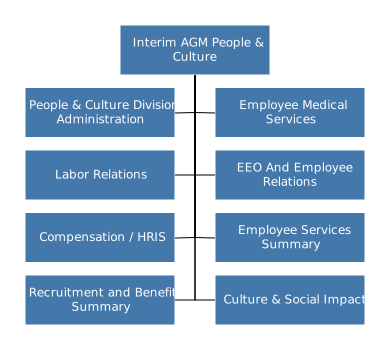
Headcount | Expenses | |||||
|---|---|---|---|---|---|---|
Operating | Capital | Total | Net Labor | Non-Labor | Total | |
People & Culture Division Administration | 10 | 0 | 10 | $2,308 | $369 | $2,677 |
Employee Medical Services | 15 | 0 | 15 | $1,233 | $328 | $1,561 |
Labor Relations | 13 | 0 | 13 | $1,441 | $280 | $1,721 |
EEO And Employee Relations | 6 | 0 | 6 | $613 | $113 | $726 |
Compensation / HRIS | 16 | 0 | 16 | $1,649 | $59 | $1,708 |
Employee Services Summary | 14 | 0 | 14 | $1,296 | $395 | $1,691 |
Recruitment and Benefits Summary | 26 | 0 | 26 | $2,347 | $1,103 | $3,450 |
Culture & Social Impact | 21 | 5 | 26 | $2,150 | $589 | $2,739 |
Total | 121 | 5 | 126 | $13,037 | $3,236 | $16,273 |
Overview
The Planning and Strategy Division oversees the Service Planning and Strategic Planning & Analysis Departments. These departments advance development of business data assets, analysis and development of strategies and goals in the Authority’s Strategic Plan, development of strategic communications and outreach that are necessary in implementing the Authority’s Strategic Plan, coordination with regional planning partners, long range planning, community and station area planning, advancement of major planning and expansion projects, management and improvement of transit service, and the Annual Service Plan. This work includes facilitating business innovations that stem from the strategic plan and sustainability program plan, often acting as a business analyst for interdepartmental corporate initiatives and long-term capital and service planning project activities.
Principal Responsibilities
Service and Schedules
Plan and schedule service for City, Suburban (Victory and Frontier) Contract Ops transit division and Regional Rail operations. Monitor and analyze route performance in accordance with applicable service standards to develop proposals for service improvements. Coordinate the relocation and change to bus stop locations. Provide support for capital projects and diversions. Develop public schedule materials, including paper and web timetables, as well as data feeds that power apps and other external and internal systems. Work with public and private partners to implement improvements to existing service and develop new service. Serve as liaison with city and county planning agencies, municipal governments, and Transportation Management Associations (TMA) regarding service planning issues. Coordinate the tariff and public hearing process for all proposed route changes. Provide support for strategic planning efforts like Regional Rail Master Plan, New Bus Network Implementation, and others.
Strategic Planning and Analysis
The efforts of the Strategic Planning and Analysis Department help to create and implement a shared vision for the future among the various internal and external stakeholders, prioritizing capital funding and the advancement of enhanced service to build towards a unified, lifestyle transit network.
Strategic Planning
SEPTA adopted its most recent Strategic Plan, SEPTA Forward, in February 2021. This plan establishes a clear vision for the future with transit at the core of a resilient, prosperous, and equitable community for everyone. The plan’s goals: to develop a proactive organization, provide an intuitive experience, and deliver a seamless transit network, that will propel us, our communities, and our region forward.
Major Planning Programs
SEPTA is advancing several major planning programs, including SEPTA’s New Bus Network, Trolley Modernization, Transit Oriented Communities, Reimagining Regional Rail, and Project Metro. These projects are multidisciplinary programs that will include significant public outreach and require multiple SEPTA departments to work together to advance.
Long-Range Planning
Long-range plans include a comprehensive analysis of existing systems, ridership trends, and demographic data to make recommendations for strategic investments to serve current and future transit needs. Such long-range plans include studies for optimizing our rail system, improving existing facilities to support long-term growth, and analyzing bus service networks. SEPTA works closely with DVRPC to include these plans in the region’s adopted Long Range Plan.
Policy and Value Proposition
Develop presentation and communication materials that make the business case for increased investment in SEPTA, emphasizing transit’s value proposition to drive economic growth, promote equity, advance sustainability, and improve public health, safety, and quality of life. Collaborate with SEPTA Communications and Government Affairs to disseminate this information through brochures, presentations, and the SEPTA website at planning.septa.org.
Municipal and Regional Plan Coordination
SEPTA participates in comprehensive plans, transportation studies, neighborhood plans, streetscape designs, and station area or Transit Oriented Communities (TOC) plans. These studies impact SEPTA and customers in some manner, from how a roadway functions, to envisioning new development at a train station, to recommending new or improved service concepts.
Comprehensive Station and Service Analysis
This type of plan enables high-quality, community-supported improvements to SEPTA stations and service. Comprehensive plans look holistically at infrastructure and service, not only to improve the customer experience and increase ridership, but also to identify ways to encourage economic development and improve multi-modal (pedestrian, bicycle, bus, and vehicular) access.
Project Development
The Project Development Department is responsible for creating and coordinating a capital project development process that includes prioritizing capital projects based on the Strategic Business Plan.
Capital Project Development Process
Phase I of the Project Development Process is complete after external and internal stakeholder collaboration. The new process, Capital Projects Transparent Reporting Accountability Collaboration (CapTRAC) is now in implementation, Phase II. CapTRAC relies on standardized information requirements for approvals for funding through delivery of capital projects. The two staff members of the Project Development Department with extensive project development and engineering management experience provide oversight and direction for this initiative, including the transition to a modernized, automated project database, which will provide reporting on Key Performance Indicators (KPIs). The new process and reporting data will provide trending analytics to focus on opportunities for cost savings and improved quality.
Project Scoping and Conceptual Design
This Department also supports Planning and Strategic Initiatives in engineering feasibility, alternatives analysis, and site evaluation for capital initiatives such as SEPTA’s New Bus Network ends of lines, Regional Rail Fleet and Facilities Study, and other SEPTA initiatives.
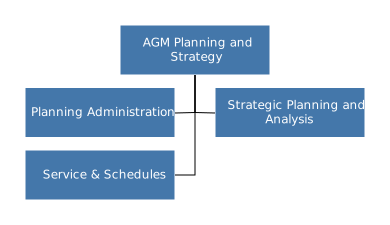
Headcount | Expenses | |||||
|---|---|---|---|---|---|---|
Operating | Capital | Total | Net Labor | Non-Labor | Total | |
Planning Administration | 2 | 1 | 3 | $312 | $18 | $330 |
Strategic Planning and Analysis | 20 | 6 | 26 | $1,462 | $3,062 | $4,524 |
Service & Schedules Summary | 29 | 0 | 29 | $2,873 | $45 | $2,918 |
Total | 51 | 7 | 58 | $4,647 | $3,125 | $7,772 |
Overview
SEPTA's System Safety Division consists of a team of experienced safety professionals who are dedicated to ensuring and enhancing the safety of all of SEPTA's employees and customers. The Division serves as the corporate safety consultant for all employees, supporting regulatory compliance with a wide range of safety and environmental regulations, including oversight of SEPTA's Safety Management System (SMS) and Public Transportation Agency Safety Plan (PTASP). Through proactive training, incident investigation, risk assessment and mitigation, and emergency preparedness planning, the Division fosters a culture of continuous safety improvement across all modes of transit operations.
Principal Responsibilities
System Safety
System Safety performs a wide range of tasks that are designed to ensure and enhance the safety of our employees, customers and the Community. System Safety acts as SEPTA’s safety liaison to various regulatory agencies, including the NTSB, FRA, FTA, EPA, PaDEP, and PennDOT, while collaborating cross-departmentally to integrate safety into planning, operations, and maintenance activities.
Safety Innovation and Environment, and SMI Implementation
The Safety Innovation and Environment team includes the Occupational Safety and Environmental Management (OSEM) program, Safety Statistics Reporting, Training and Communications, and Sustainability. OSEM protects employees from workplace hazards while meeting environmental regulations. Through comprehensive Safety Statistics Reporting systems, the division tracks incidents and performance metrics to drive data-driven improvements, provides important communications and delivers critical safety training to SEPTA's workforce. The Sustainability program advances environmental stewardship and operational efficiency across the Authority's transit network. The team oversees energy and utility management systems, identifies opportunities to reduce consumption and costs, and supports the expansion of zero-emission transit technologies. Through community engagement initiatives and sustainable design practices, the team enhances regional air quality while reinforcing SEPTA's commitment to environmental protection and public health.
In addition, the overall management of the SMI Action Plan implementation sits within this team and aligns SEPTA programs and processes with FTA oversight requirements and integrates federal safety management principles throughout SEPTA's organizational structure.
Safety Culture and Safety Risk Management
The Safety Culture and Safety Risk Management Program fosters a proactive safety environment across SEPTA by promoting hazard identification, risk assessment, and continuous improvement at all organizational levels. This team leads the development and implementation of systematic risk management processes that evaluate potential safety threats and implement mitigation strategies before incidents occur. The Program oversees compliance and assurance activities, ensuring that SEPTA meets all federal and state safety requirements and industry standards. The team also maintains SEPTA's emergency management capabilities, developing and coordinating emergency response plans, conducting training and exercises, and ensuring organizational readiness to respond effectively to incidents, natural disasters, and other emergency situations. Additionally, the Program coordinates the development of comprehensive responses to all Corrective Action Plans (CAPs) issued by the FTA and PennDOT, managing implementation timelines and verification processes to demonstrate effective resolution of identified safety concerns. Through these integrated efforts, the Program strengthens SEPTA's safety culture, enhances emergency preparedness, and maintains accountability to regulatory agencies and the communities we serve.
Construction Safety
Safety Engineering and Construction
The Safety Engineering and Construction team develops comprehensive programs and protocols to minimize construction-related hazards across SEPTA's capital projects. The team reviews project designs throughout all phases to ensure compliance with regulatory codes and conducts regular audits of both third-party contractor and in-house projects to verify adherence to safe work practices. Through targeted training on OSHA regulations, plan reviews, and ongoing site monitoring, the Department ensures that safety guidelines and protocols are consistently followed, protecting workers and the public during all construction activities.
Accident Reduction Coordination
Accident Prevention and Investigations
The Accident Prevention and Investigations department conducts comprehensive reviews of Authority safety data to identify trends, assess risks, and develop targeted mitigation strategies that prevent incidents and reduce their frequency. By proactively analyzing patterns and hazards before they result in incidents, the Department supports continuous safety improvement across SEPTA's operations. The team ensures regulatory compliance for all accident and incident notifications, serving as the Authority's liaison to regulatory agencies to maintain strong communication and coordination. Through thorough investigation of accidents and incidents, the Department applies corrective actions and lessons learned to prevent future occurrences and enhance overall system safety.
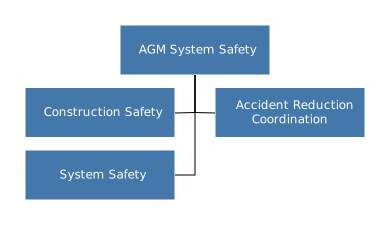
Headcount | Expenses | |||||
|---|---|---|---|---|---|---|
Operating | Capital | Total | Net Labor | Non-Labor | Total | |
Construction Safety | 0 | 8 | 8 | $138 | $2 | $140 |
System Safety | 57 | 5 | 62 | $6,028 | $2,755 | $8,783 |
Accident Reduction Coordination | 6 | 0 | 6 | $602 | $0 | $602 |
Total | 63 | 13 | 76 | $6,768 | $2,757 | $9,525 |