A Letter from SEPTA Leadership
The lack of a statewide transit funding solution has forced SEPTA to take extraordinary measures to fully fund transit system operations for Fiscal Year 2026.
In October, the SEPTA Board approved those measures in the form of budget amendments allowing $394 million to be transferred from the capital budget to cover day-to-day expenses. This will provide enough funding to balance SEPTA’s Operating Budget for Fiscal Year 2026 and 2027– avoiding service cuts during that time and enabling implementation of the New Bus Network to move forward.
While SEPTA is pleased to offer customers some stability, it comes at a great cost. Due to funding limitations and the impact of inflation, SEPTA already was forced to defer or descope 44 projects totaling $1.8 billion from its Fiscal Year 2026 Capital Budget & 12 Year Program as originally proposed and approved in June. This proposed budget amendment will defer 5 additional projects totaling $394 million. The more than $2 billion in combined capital budget cuts will worsen a state of good repair backlog now totaling more than $10 billion.
What does this mean? It means that long-planned accessibility improvements at more than a dozen stations will be deferred indefinitely. It means that bus and rail fleets will continue to age, potentially creating new maintenance issues in the future. And it means that the pace at which SEPTA moves into the future with new services and technologies will be far slower than we had hoped. Virtually all remaining capital funds will be dedicated to financial obligations, safety-critical and state of good repair projects, and it will be so until additional funding is received to fill the gap in need.
Clearly, this is far from an ideal solution to take from an already underfunded capital program to pay for day-to-day operations. But it was the best option that was available – and it will mean stability for customers after tumultuous months that included unprecedented, across-the-board service cuts.
This entire experience and its aftermath underscore the urgent need for a comprehensive funding solution. Without one, service cuts will be back in play as early as Fiscal Year 2028. In the meantime, SEPTA remains committed to working within budget constraints to continue to improve – and to provide the safe, reliable service that customer expect and deserve each and every day.
For the fiscal years beginning July 1, 2012, through July 1, 2023, the Government Finance Officers Association of the United States and Canada (GFOA) presented a Distinguished Budget Presentation Award to SEPTA for its Annual Budget Book. In order to receive this award, a governmental unit must publish a budget document that meets program criteria as a policy document, financial plan, operations guide, and communications device.
Due to the current funding crisis, SEPTA implemented a series of fiscal measures to reduce planned spending. Therefore, SEPTA did not submit for the Annual Budget GFOA award for the fiscal years starting July 1, 2024.
Southeastern Pennsylvania Transportation Authority
| Chair
Kenneth E. Lawrence, Jr. |
|
| Vice-Chair
Honorable Marian D. Moskowitz |
|
Bucks County
John F. Cordisco, Esquire Matthew L. Trzaska | Chester County
Honorable Marian D. Moskowitz Kevin L. Johnson, P.E. | Delaware County
Daniel R. Muroff, Esquire Mark H. Dambly |
Montgomery County
Honorable Neil K. Makhija Kenneth E. Lawrence, Jr. |
Governor's Appointee | City of Philadelphia
Michael A. Carroll, P.E. Richard R. Harris, Esquire |
| Robert D. Fox, Esquire |
|
Senate Majority Leader Appointee
Thomas Jay Ellis, Esquire |
| House Majority Leader Appointee
Honorable Martina White |
Senate Minority Leader Appointee
William J. Leonard, Esquire |
SEPTA Officers | House Minority Leader Appointee
Esteban Vera, Jr. |
| General Manager
Scott A. Sauer |
|
| Interim Chief Financial Officer/Treasurer
Erik S. Johanson |
|
| General Counsel
Mark Prior, Esquire |
|
| Controller to the Board
Vacant |
|
| Secretary to the Board
Carol R. Looby |
|
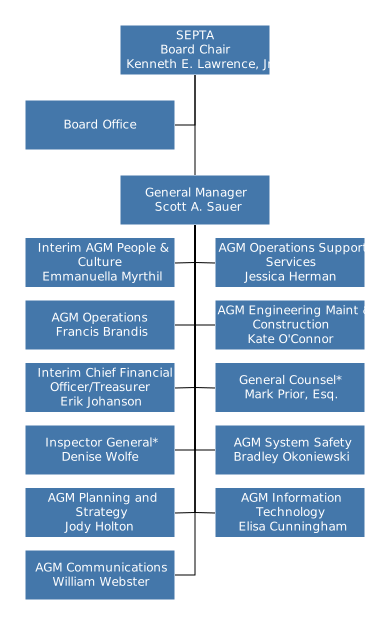
Corporate Team Organization Chart
SEPTA BOARD
SEPTA is governed by a Board consisting of fifteen Directors. The City of Philadelphia and the Counties of Bucks, Chester, Delaware, and Montgomery each appoint two members to the Board. The Pennsylvania Senate and House collectively appoint four members and the Governor of Pennsylvania appoints one representative.
* Dual report to Board Chair
The Southeastern Pennsylvania Transportation Authority (SEPTA) was formed on February 18th, 1964, under the auspices of the Metropolitan Transportation Authorities Act enacted by the Commonwealth of Pennsylvania in 1963. But the history of mass transit in Southeastern Pennsylvania started more than a century before that.
Horse-drawn omnibuses and railroads date to the 1830s. The Philadelphia, Germantown, & Norristown Railroad was chartered in 1831. Over time, horse-drawn omnibuses gave way to horse-drawn streetcars, which gave way to electric streetcars, and, in time, subways and buses. These systems, all first chartered one street at a time by separate companies, were gradually consolidated. In 1884, almost all 436 miles of track were brought under the auspices of the Union Traction Company.
In 1902, when proposals for rapid transit began coming closer to realization, the Union Traction Company merged with the various interests holding the rapid transit franchise to form the Philadelphia Rapid Transit Company (PRT). From 1904 to 1908, PRT built the Market Street Subway-Elevated. Service began in 1907 from City Hall to 69th Street in Upper Darby, where it met the interurban trolleys of the Philadelphia & West Chester Traction Company and Philadelphia & Western Railroad. Service was extended from City Hall to the South Street Ferry terminal via Delaware Avenue beginning in 1908. At the time, the Market Street line was the only subway in the United States to be financed solely with private capital. This feat fiscally exhausted the PRT, ultimately compelling it to sell off its other franchises.
Thereafter, mass transit gradually became an increasingly public concern. In 1912, The Pennsylvania General Assembly created the Philadelphia Department of City Transit, which produced a series of ambitious annual reports from 1912 to 1923 that proposed a municipal rapid transit system, including the 1922 extension of the Market Street Subway-Elevated to Frankford and a four-track subway under Broad Street that opened in 1928 from Olney to City Hall. The Broad Street Subway was extended southward to South Street in 1930 and to Snyder Avenue in 1938, with a vestigial tail under Locust Street. Bridge Line service, which operated between 8th & Market and Camden via the Ben Franklin Bridge beginning in 1939, began to utilize the Locust Street tunnel in 1953, extending service to 16th Street. This line was sold to the DRPA in the 1960s and was extended to Lindenwold, NJ in 1969 as PATCO.
A Ridge Avenue Spur of the Broad Street Line opened in 1932, connecting 8th & Market Streets with Girard Avenue. The Broad Street Line was also extended northward from Olney to Fern Rock in 1956 and further southward to Pattison Avenue in 1973. The City also financed extending the Market Street Subway-Elevated tunnel under the Schuylkill River to 46th Street, opening in 1955, straightening it to run under, rather than around, City Hall and extending the trolley tunnel to 40th Street. The Delaware Avenue portion of the Market-Frankford Line to South Street was abandoned in 1939, after which all trains operated between Frankford and 69th Street.
Despite increasing public interest, mass transit continued in private operation for several more decades. The PRT was reorganized from bankruptcy as the Philadelphia Transportation Company (PTC) in 1940. After the Great Depression and Second World War, expanded use of the private automobile began a multi-decade regional decentralization. The City of Philadelphia’s 1951 charter abolished the Office of City Transit and merged its functions under the Department of Public Property until the City established the Urban Traffic and Transportation Board in 1955. The Board was an advisory body that comprised various private, public, and government transportation interests. Its most noteworthy accomplishment was publishing a staff report that recommended various improvements and the creation of a multijurisdictional entity to coordinate, finance, and build transportation improvements.
The Board also served as the instrument for the first major public intervention in commuter railroad service. The sundry small railroads in and around Philadelphia that began emerging in the 1830s quickly fell mostly into the control of the Reading Company or Pennsylvania Railroad. By the 1930s, those companies had organized and in large part electrified an expansive network of commuter rail lines funneling into the Reading Terminal or the Pennsylvania Railroad’s Suburban Station. The city wanted to relieve its streets from some of the congestion created by expanded use of private automobiles. Thus, in 1958, the board oversaw Operation Northwest, whereby the railroads lowered fares, raised frequencies, and offered discount intermodal transfer tickets on their Chestnut Hill lines in exchange for public subsidies. Ridership rose by 15% and the experiment seemed a success. Thus followed Operation Northeast, which implemented the same policies on the Fox Chase line, with the result of a 250% rise in passengers. The success of these operations led to their expansion onto the inner segments of the Norristown and Trenton lines as well as the creation of the Passenger Service Improvement Corporation in 1960 to administer the subsidy program.
The commuter network reached far beyond the city at its heart and so did its possibilities. Thus, in 1961, Montgomery and Bucks counties joined the City of Philadelphia to create the Southeastern Pennsylvania Transportation Compact, or SEPACT, to expand commuter rail improvements throughout the region. Delaware County had been invited but declined at the behest of the Philadelphia Suburban Transportation Company, popularly known as the “Red Arrow”. Station improvements, parking expansion, extension of electrification on the Fox Chase line, and acquisition of the first Silverliner fleet followed.
In 1964, SEPTA was established, adding Chester and Delaware counties to a five-county regional governance entity capable of fully absorbing the functions of PSIC and SEPACT. SEPTA’s role quickly expanded beyond being an instrument for public subsidies to commuter railroads when it acquired the property of the PTC in 1968, thus also assuming its operations, assembling a planning staff, and preparing its first capital program. PTC operations included the Frankford-Elevated and Broad Street Subway, which are property of the City of Philadelphia. SEPTA acquired the bus routes and remaining interurban rail transit lines of the Red Arrow in 1970. In 1976, SEPTA acquired the routes of Schuylkill Valley Lines, primarily serving Montgomery County, and established the SEPTA Frontier Division. These routes were totally reorganized in 1977 and have been expanded significantly in subsequent years. Together with the acquisition of several smaller suburban private carriers such as Reeder’s Inc. (formerly Short Lines) in Chester County, SEPTA’s suburban transit footprint was significantly expanded.
By the time SEPTA acquired PTC and Red Arrow, only a handful of electrically powered trolley lines had survived. In the City, challenges included aging equipment and infrastructure, and increased traffic congestion along narrow street cart ways causing severe service reliability issues. Five of those operating today utilize the trolley subway to reach Center City. The other City route along Girard Avenue operates on a wider street cart way for much of its mileage. In the suburbs, Red Arrow had abandoned trolley lines serving Ardmore and West Chester, substituting buses. The two surviving lines to Media and Sharon Hill operate on almost exclusively grade separated rights of way. SEPTA also acquired the totally grade separated Norristown High-Speed Line (NHSL) from Red Arrow. NHSL equipment which dated to the 1920s and 1930s was updated in 1993. Both City and suburban trolley equipment age continues to be a challenge as the majority of the fleet of trolleys consists of 1980 vehicles that are not ADA compliant. (Girard Avenue service is provided by a fleet of 1940s vintage PCC cars retrofitted with ADA lifts, which were recently restored.)
The Center City trolley tunnel built alongside of the Market-Frankford Line (MFL) tunnel was opened in 1906 and trolleys looped at City Hall. In 1955, along with the MFL, the tunnel was extended under the Schuylkill River with new trolley portals at 36th and 40th Streets. Five trolley routes utilize the tunnel (Route 10 Lancaster Avenue, Route 11 Woodland Avenue, Route 13 Chester Avenue, Route 34 Baltimore Avenue, and Route 36 Elmwood Avenue).
SEPTA also acquired several trackless trolley routes from PTC. Today, three operate from Frankford or Arrott Transportation Centers: Route 59 Castor Avenue, Route 66 Frankford Avenue, and Route 75 Wyoming Avenue.
The Pennsylvania Railroad merged with the Central Railroad of New York to become the Penn Central Railroad in 1968 but could not save itself and declared bankruptcy in 1970, was nationalized in 1974, and passed all of its railroad assets to the Consolidated Railroad Company, or Conrail, in 1976. The Reading Company succumbed to a similar fate, declaring bankruptcy in 1971 and had divested itself of its railroad property by 1975. Conrail continued the commuter services of the defunct railroads while SEPTA obtained funding to procure the Silverliner IV railcars to replace the most aged portions of their Pennsylvania and Reading fleets. Meanwhile, the City of Philadelphia secured funding for construction of the Center City Commuter Connection, a tunnel first proposed in the 1950s that would join the two separate sets of commuter rail lines into a single system and replace the slow, awkward stub-end terminals with more efficient, higher-capacity through-running service.
Conrail operated the commuter rail services until the beginning of 1983, when the railroads were added to the SEPTA portfolio of operations. On November 12th, 1984, the Center City Commuter Connection was opened for revenue service. This necessitated abandonment of the remaining diesel services on the commuter rail network, but also endowed Philadelphia with a commuter rail system that was unique and outstanding in the United States as being wholly electrified and through-running. On April 28, 1985, SEPTA’s Airport Line began service to Philadelphia International Airport, representing one of the nation’s first direct rail-to-airport connections. SEPTA’s Access paratransit service also commenced service in the 1980s, providing door-to-door service across much of southeastern Pennsylvania. To this day, SEPTA remains one of the only fully multimodal mass transit agencies in the United States, in that it administers and operates a comprehensive fixed route mass transit, paratransit, and commuter rail system under the auspices of a single transportation authority.
In the 40 years since, SEPTA has continued to operate almost all public transportation in Southeastern Pennsylvania and faithfully borne the burden of maintaining a wide-ranging and diverse century-plus legacy it inherited. The Authority has constantly renewed its bus fleet, while also developing overhaul practices to allow vehicles to have longer, more productive useful lives, and procured new rolling stock to replace what it inherited from private operators. SEPTA has also renewed its rapid transit infrastructure by renovating stations, extending the Broad Street Line’s express tracks from Girard to Olney and ultimately to Fern Rock, reconstructing the West Market and Frankford Elevateds and comprehensively modernizing the Norristown High Speed Line. It also faced and met a major challenge when the viaduct from Center City to Wayne Junction was so deteriorated from age that it was shut down for eleven months in 1992 and 1993 for the Railworks project, under which SEPTA fully reconstructed the line.
Today, SEPTA’s system reflects influences as diverse as the patchwork of small street railways that first emerged in the middle of the nineteenth century, the routes of which some SEPTA bus routes still follow, and railroad titans that built lines that came to define the geography of the region. This extensive and remarkable legacy brings with it daunting challenges, but also exciting possibilities as SEPTA pursues its vision for the future of Southeastern Pennsylvania.